


I rarely watch movies or TV shows, but I’ve been deep in YouTube for over ten years. Tutorials, vlogs, talks, deep dives, long-form essays, music, comedy. Thousands of hours. It’s where I learn and where I go first when I want to understand something new.
So when I decided to build my next product, I didn’t have to think about which platform. I picked the one I know best, not as a creator (I'll change it), but as someone who has spent a decade on the other side of the screen.
Here’s what pushed me over the edge. A close friend of mine is a Catholic priest with a YouTube channel of over 2 million subscribers. I help him with the tech side. His small team (me included, on my free time) manages the channel, reads comments, and tries to understand what resonates. But when you have thousands of comments across hundreds of videos, reading them manually doesn’t scale. The signal gets buried in noise. The team wanted better visibility into what the audience is actually saying, what they’re asking for, what they love, and what frustrates them.
That problem stuck with me. And I realized it’s not unique to big channels. Any creator with a growing audience faces the same thing: the comments hold the answers, but nobody has time to mine them.
What Perspion does
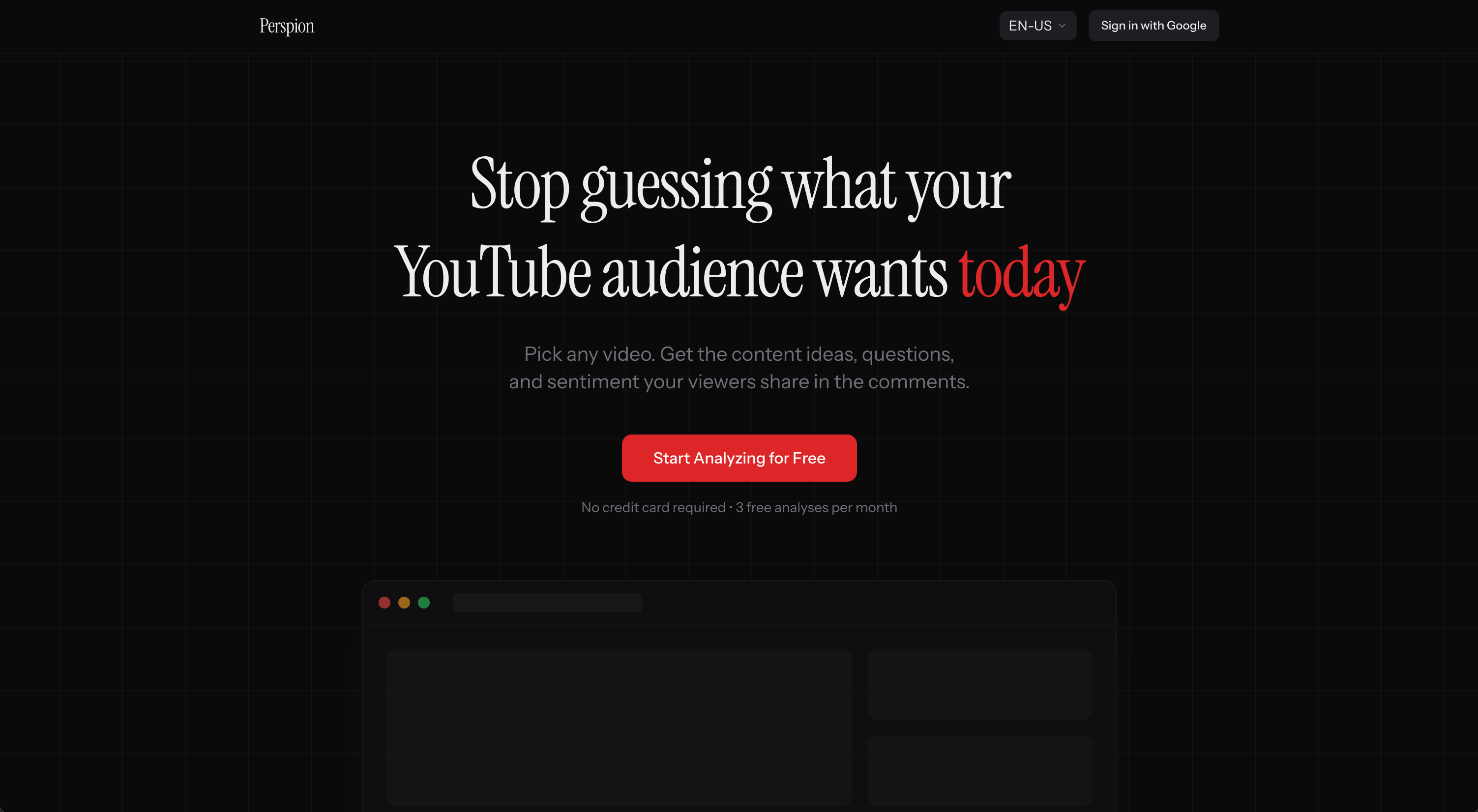
Perspion lets you point at any YouTube channel, select the videos you care about, and run an AI-powered analysis on every comment. A couple of minutes later, you get a full breakdown:
Content Radar: What topics your audience is requesting, ranked by how often they come up. You never have to wonder “What should my next video be about?”
Sentiment Map: How people feel about each video. Not just “positive vs negative” but what specifically they loved and what needs attention.
Question Bank: Every question from your comments, extracted and grouped. Thirty-four people asking the same thing? Now you know.
Actionable Insights: Plain-language recommendations based on what the data shows.
The name comes from Latin. "Perspicere" means to see clearly, to perceive, to look through. It probably doesn't sound like a typical SaaS name, but then again, a fruit company named itself Apple and did fine, actually way better than fine. My previous product, Gradon, comes from "gradus" (step, progress). Latin roots are a WheyDev thing now.
How I built it: The 17-prompt framework
Before writing any code, I wrote 17 architecture prompts. Each one is a complete brief for Claude Code covering one step of the build: exact database schemas, UI layouts, API structures, copy, error handling, everything.
I spent more time writing the prompts than I’ll spend executing them. The prompts are the architecture. The code follows.
Here’s the sequence:
Foundation (Prompts 1-2)
Project setup and internationalization. English and Portuguese from day one (at least for Perspion). Exact fonts, colors, and folder structure. Setting up i18n early means every component built after this is automatically bilingual. Retrofitting it later is painful.
Surface (Prompt 3)
The landing page. Dark mode, premium aesthetic, seven sections with specific copy and layout. This page can go live before a single feature works.
Plumbing (Prompts 4-6)
Google authentication, the database schema with row-level security so users only see their own data, a YouTube channel with video search, and the comment fetching pipeline.
Core value (Prompts 7-8)
The AI analysis engine that categorizes every comment (content request, question, positive feedback, negative feedback, discussion, spam) and the results dashboard with seven visual cards. I believe this is why people pay.
Retention (Prompts 9-10)
Analysis history with permanent links, search, and pagination. Usage limits and billing tiers (Free, Pro, Agency) with proper enforcement. This turns a tool into a business.
Premium (Prompt 11)
PDF export for paying users. Full formatted report, downloadable and shareable.
Professional (Prompts 12-15)
Error handling for every failure mode, a public changelog, comprehensive project documentation, terms of service, and privacy policy covering everything from subscription cancellation to service discontinuation, written for a real business entity.
Measurement (Prompt 16)
Analytics with a defined conversion funnel: channel searched, video selected, analysis started, analysis completed. Plus monetization signals: When someone hits their free limit, do they click "upgrade"? You can't improve what you don't measure, but tracking without a plan just gives you noise.
Security (Prompt 17)
Two-layered audits before launch. A general sweep covering secrets, unprotected routes, dependency vulnerabilities, and missing security headers. Then, a database-specific deep dive checking that access policies work correctly and simulating what an unauthorized user could see.
The reusable sequence
Strip away the YouTube-specific parts, and you get a framework for most of any SaaS MVP:
Stack setup
Internationalization
Landing page
Auth + data model
Core input UX
Data pipeline
Processing logic
Results display
History + persistence
Billing + limits
Premium features
Polish + errors
Changelog
Documentation
Legal
Analytics
Security audit
I’m planning to use this exact sequence for every WheyDev product going forward. The prompts change, but the structure doesn’t. At least until I find a better solution. I'm always improving as a professional.
And honestly, 17 prompts were just the starting point. After running them, I created additional prompts for adjustments, refinements, and things I only noticed once I saw the product running. That’s normal. As a friend of mine says, software is a living thing. It always evolves. The framework gives you the skeleton. The flesh grows over time.
Try it
Perspion is live right now at perspion.whey.dev. Three free analyses and no credit card required. Point it at your channel and see what your audience has been trying to tell you.
This is a side project I'm building in my spare time, and I'll keep sharing how it goes here and on social media.
Perspion is the second product from WheyDev, a micro-SaaS studio building tools for creators. The first, Gradon, is a career progress tracker at gradon.whey.dev.